
The role-specific workforce layer
Every employee should have an AI agent trained for their role.
Delphi builds employee AI agents connected to your Company Brain, so your team can work faster, follow the right rules, and stop starting from a blank chat box.
The blank-box problem
Access to AI is not the same as adoption.
Companies gave employees ChatGPT and most employees barely use it. Delphi gives them role-specific agents trained on their job, company, tools, and workflows.
Employees are left to determine
Most employees are handed a blank chat box. Without a defined role, trusted context, or operating boundaries, useful adoption remains inconsistent.
- What to ask
- What context to provide
- What company rules apply
- Which workflows AI should support
- When to trust the output
- When to escalate to a human
Employee AI Agents
Assistants designed around the actual work of a role.
Role-specific AI employee assistants begin with a clear mandate, approved knowledge, familiar tools, and the workflows the person is already responsible for.
- 01
Sales Agent
Follow-up, lead research, proposal drafts, and objection handling.
- 02
Admin Agent
Scheduling, inbox support, document preparation, and task routing.
- 03
Operations Agent
SOP lookup, status reporting, and process guidance.
- 04
Client Service Agent
Client updates, FAQs, response drafts, and escalation paths.
- 05
Recruiting / HR Agent
Candidate screening support, onboarding, and internal FAQs.
- 06
Executive Agent
Decision briefs, meeting preparation, and strategic summaries.
Connected intelligence
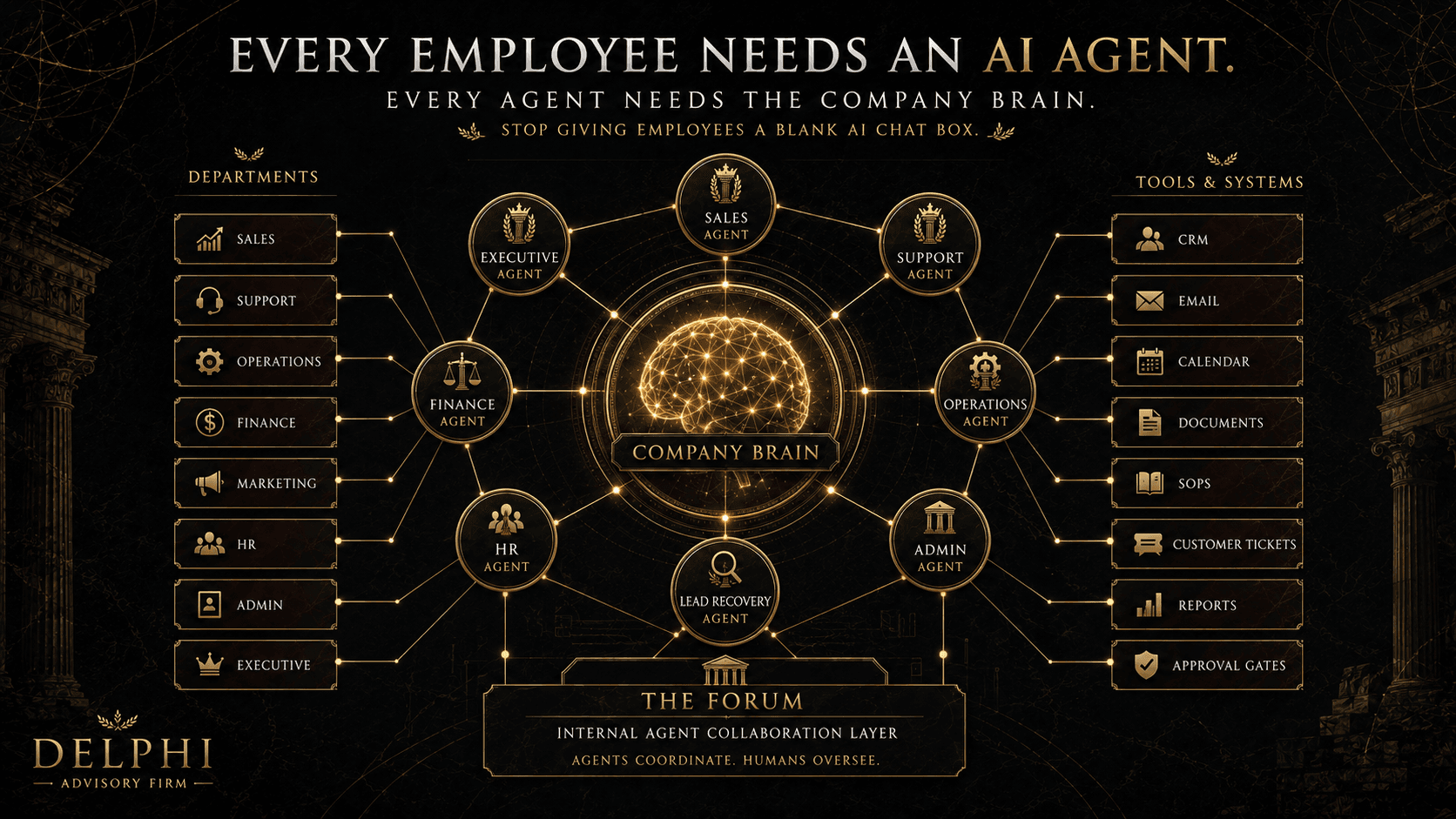
Every agent connects back to the Company Brain.
Delphi gives every employee an AI Agent connected to your Company Brain, so your team can work faster, share knowledge, automate routine tasks, and collaborate through an intelligent operating system built for your business.
The agent becomes powerful because it works from trusted company context. It is not just a chatbot. It is a role-specific assistant operating from the company’s knowledge, rules, tools, workflows, and examples.
In the starter offers, the agent may support the founder or one workflow. In the enterprise offer, each employee can receive a role-specific agent connected to the central Company Brain.
Training and adoption
Delphi builds the agents and prepares employees to use them.
Technology becomes operational only when employees know how to apply judgment, verify outputs, and work inside clear boundaries.
- 01
Prompting for the role
- 02
Using context and examples
- 03
Reviewing outputs
- 04
Following escalation rules
- 05
Data privacy basics
- 06
Approved use cases
- 07
Turning repetitive tasks into agent workflows
The agent network
Role-specific at the edge. Connected at the center.
The thesis
A network, not one chatbot.
The future of work is not one chatbot for the company. It is a network of role-specific AI agents connected to the people, departments, data, and workflows of the business.
The next decision
Start with the first three roles that create the most leverage.
Delphi can help identify which employee AI agents your company should build first, how they should connect to your Company Brain, and how your team should be trained to use them.